
Picking the right size HVAC system matters more than picking the brand. Get the size wrong and you pay for it every month in higher bills, uneven rooms, and a system that wears out early. This guide walks you through how HVAC sizing actually works, why “bigger” is not “better,” and how to land on the right number before you call a contractor.
Short answer: HVAC size is measured in tons (1 ton = 12,000 BTU per hour). A rough starting point is one ton for every 400–600 square feet, but the only reliable method is a Manual J load calculation, the industry standard from the Air Conditioning Contractors of America (ACCA) that the U.S. Department of Energy recommends for sizing residential equipment. Want a fast ballpark first? You can estimate your home’s heating and cooling load with our HVAC load calculator in a couple of minutes, then use this guide to understand what the number means.
Why HVAC sizing is the decision that quietly costs you the most
Your HVAC system has one job: add or remove exactly as much heat as your house gains or loses. Size it to match that load and it runs in long, steady cycles that keep temperature and humidity even. Miss the load and everything downstream suffers.
Contractors describe capacity in two units you’ll see on quotes. BTU (British Thermal Unit) is the amount of heat energy moved per hour. A “ton” of cooling equals 12,000 BTU per hour, a holdover from the days of cooling with actual blocks of ice. So a 3-ton air conditioner moves 36,000 BTU of heat out of your home every hour.
The goal is a system matched to your house, not the biggest one that fits the budget. Here’s why that cuts both ways.
What happens when your system is the wrong size
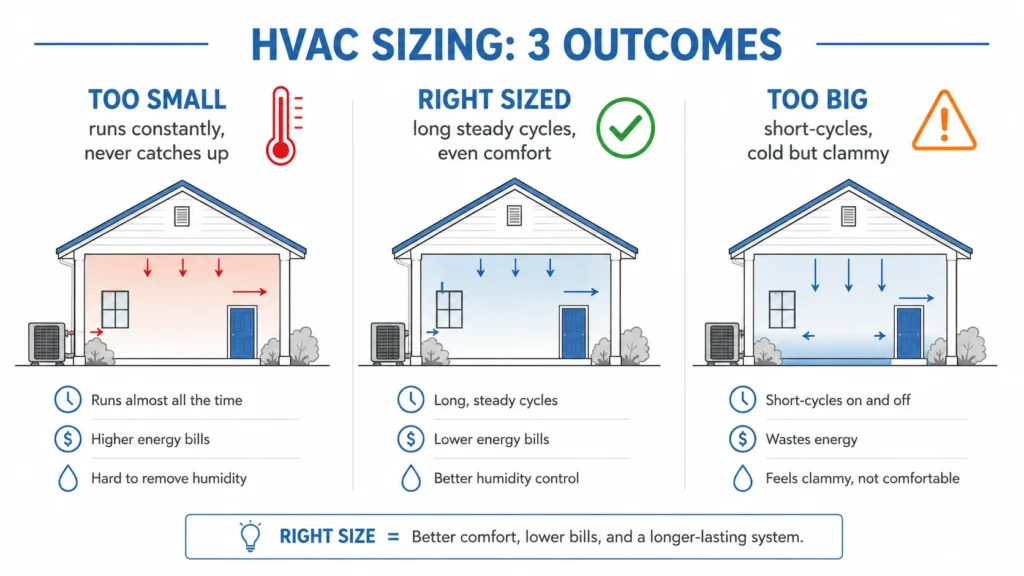
Too big: the most common and most expensive mistake
Oversizing feels safe, so it’s the default many people reach for. It backfires.
An oversized air conditioner cools the air fast, then shuts off before it has run long enough to pull moisture out of the air. You’re left with a house that’s cold and clammy. Because it keeps hitting the target and switching off, it “short-cycles,” starting and stopping far more than it should. That constant on-off wears out the compressor and drives up your bill.
This isn’t just theory. The Department of Energy notes that oversized equipment costs more upfront, runs less efficiently, and can hurt comfort. One Florida study it cites found roughly a 9% jump in annual cooling electricity use for units oversized by 50% or more (U.S. Department of Energy, FEMP). Short-cycling also does the most damage in humid climates, where poor moisture control turns a comfort problem into a mold-and-mildew problem.
Too small: it never catches up
An undersized system runs almost nonstop and still can’t reach the temperature you set on the hottest or coldest days. Running constantly means higher bills and a shorter lifespan, since the equipment rarely gets a break. On design-day extremes, you simply stay uncomfortable.
The sweet spot is a system that runs long, quiet cycles and shuts off only when the house is truly comfortable.
How HVAC sizing is actually done: Manual J
The professional method is a Manual J load calculation, published by ACCA as the ANSI-recognized standard for residential load sizing. It answers one question with real numbers: how much heat does this specific house gain in summer and lose in winter?
A proper Manual J looks at far more than square footage. It accounts for:
- Climate and design temperatures for your specific location
- Insulation levels (R-values) in walls, attic, and floors
- Windows — their size, direction they face, U-factor, and how much sun they let in
- Air leakage (infiltration) around doors, windows, and gaps
- Ductwork — where it runs and how much it leaks or loses
- People and appliances that give off heat
- Shade from trees, overhangs, and neighboring buildings
Once the load is known, contractors use a companion procedure, Manual S, to pick equipment that matches it. The Department of Energy points to Manual J and Manual S as the recommended U.S. sizing procedures for exactly this reason (U.S. Department of Energy, FEMP).
Done right, a load calculation sizes equipment far more accurately than eyeballing it. The old shortcut — “one ton per 500 square feet” — ignores your insulation, your windows, and your climate, which is why two identical-sized homes in different states can need very different systems.
The rule of thumb (and when to trust it)
As a rough screen, many pros plan for about 20 BTU per square foot of living space, adjusting up for hot, sunny, poorly insulated homes and down for cooler climates with good insulation and lower ceilings. That translates to roughly one ton per 400–600 square feet.
Use that only to sanity-check a quote, never to place an order. A rule of thumb can’t see your attic insulation or your west-facing wall of windows. Think of it like guessing someone’s weight from their height: close enough for a first impression, useless for a prescription.
A worked example
Say you have a 2,000-square-foot home in a mixed climate with average insulation and a normal number of windows.
Using the 20 BTU-per-square-foot rule of thumb:
2,000 sq ft × 20 BTU = 40,000 BTU per hour
40,000 ÷ 12,000 BTU per ton = about 3.3 tons
So you’d expect a quote somewhere near 3 to 3.5 tons. If a contractor shows up and recommends 5 tons “to be safe,” that’s your cue to ask for the Manual J worksheet. A jump that large usually means someone padded the number instead of running the math — the exact oversizing that leads to short-cycling and a damp house.
That’s the real value of running a load estimate before you get quotes: it gives you a defensible number to compare each bid against, so you can spot a padded proposal in seconds.
Understanding SEER2: sizing’s efficiency cousin
Once you know how big, the next number is how efficient. That’s where SEER2 comes in, and it’s worth understanding because it changed recently.
SEER2 (Seasonal Energy Efficiency Ratio 2) measures how much cooling you get per unit of electricity across a whole season. Higher is more efficient. On January 1, 2023, the Department of Energy replaced the old SEER metric with SEER2, which uses a tougher test (called M1) that raises the static pressure in the lab to better mimic real ductwork (The Home Depot).
Two practical takeaways:
- The same physical unit earns a SEER2 number roughly 4.5–5% lower than its old SEER rating, so don’t panic when the numbers look smaller. It’s a stricter yardstick, not worse equipment.
- There’s a legal minimum where you live. New split-system central ACs must hit at least 13.4 SEER2 in northern states and 14.3 SEER2 in the Southeast and Southwest.
A higher SEER2 costs more upfront but lowers your monthly bill. It does not change what size you need — capacity and efficiency are two separate dials.
What HVAC sizing means for cost
Size, efficiency, and price are linked. A bigger system with a higher SEER2 rating costs more, which is another reason not to oversize.
As of 2026, a full central AC-and-furnace replacement for a typical home commonly runs in the $7,000 to $20,000 range, with the national spread stretching wider depending on system type, efficiency, ductwork, and install complexity . Adding or replacing ductwork can push costs up by a few thousand dollars on its own.
These are broad ranges on purpose — anyone quoting you an exact figure without seeing your home is guessing. The most reliable way to narrow it down is to start from your actual load, then get itemized quotes. You can run the numbers for your own home before a single contractor walks through the door.
Common sizing mistakes to avoid
- Sizing to square footage alone. It ignores insulation, windows, and climate — the factors that move the load the most.
- Matching your old system’s size. Your last unit may have been wrong too, or your home may have new windows, insulation, or an addition since then.
- Letting “bigger is safer” win. Oversizing is the most common error and the one that quietly costs the most in comfort and bills.
- Skipping the Manual J. If a contractor won’t run one, ask why. A load calculation is the difference between a right-sized system and an expensive guess.
Frequently asked questions
How many BTUs do I need per square foot?
A common rule of thumb is about 20 BTU per square foot, adjusted up for hot, sunny, or poorly insulated homes and down for cooler, well-insulated ones. It’s a ballpark for sanity-checking a quote, not a substitute for a Manual J calculation. To get a number tailored to your home, try a quick load estimate.
What does “tonnage” mean in HVAC?
Tonnage is the cooling capacity of your system. One ton equals 12,000 BTU of heat moved per hour. The term comes from the amount of cooling a ton of ice used to provide — it has nothing to do with the unit’s weight.
Is it better to oversize or undersize an HVAC system?
Neither. Undersized systems run constantly and can’t keep up on extreme days. Oversized systems short-cycle, control humidity poorly, and cost more to buy and run. A correctly sized system that runs long, steady cycles is the goal.
Do I really need a Manual J calculation?
For an accurate size, yes. Manual J is the ACCA and DOE-recognized standard because it accounts for your specific insulation, windows, air leakage, and climate. A rule of thumb can get you in the ballpark, but only a load calculation gets you the right number.
What’s the difference between SEER and SEER2?
SEER2 replaced SEER on January 1, 2023, using a more realistic test that better reflects real-world ductwork conditions. Because the test is stricter, the same unit earns a SEER2 number about 4.5–5% lower than its old SEER rating. SEER2 measures efficiency, not size.
How long does an HVAC system last?
A well-sized, well-maintained system typically lasts 15–20 years. Oversized systems that short-cycle and undersized systems that run nonstop tend to wear out sooner — another reason correct sizing pays off over the life of the equipment.
The bottom line
The right HVAC size is the one that matches your home’s actual heating and cooling load — not the biggest unit that fits your budget and not a copy of your old system. Start with a load estimate to get a defensible number, insist on a Manual J from any contractor you hire, and use SEER2 to fine-tune efficiency once the size is locked in. Do that, and you’ll get a system that runs quietly, keeps your home comfortable, and lasts the way it should.
Sources
- U.S. Department of Energy, Federal Energy Management Program — Purchasing Energy-Efficient Residential Central Air Conditioners (Manual J/Manual S guidance; oversizing and the Florida 9% study)
- The Home Depot — SEER2: New 2023 HVAC Efficiency Standards (SEER2 effective date and M1 test)
- HVACDirect — Regional AC Efficiency Standards (SEER2 minimums) (13.4 / 14.3 SEER2 regional minimums)
- Air Conditioning Contractors of America (ACCA) — Manual J residential load calculation standard